How to Draw Cars for Beginners
Learn how to draw cars by simplifying them into basic forms. This beginner-friendly approach makes vehicles easier to understand and draw with confidence.

Drawing cars can feel intimidating fast. There are curves, angles, reflections, and a lot of little parts that seem to matter all at once. The problem most beginners run into isn’t detail — it’s not understanding how the car sits in space.
In this lesson, I show you a much easier way to approach drawing cars by starting with simple forms and building up from there. No fancy tricks. Just solid fundamentals that actually work.
Master Drawing Fast: Foundations to Figures
Learn how to build anything—from simple shapes to heads, hands, and full figures—using a clear, step-by-step system that actually works. This is where everything clicks.
✔ 35+ hours of training
✔ Beginner → advanced path
✔ Real structure, not guesswork
Start With Simple Shapes, Not Details
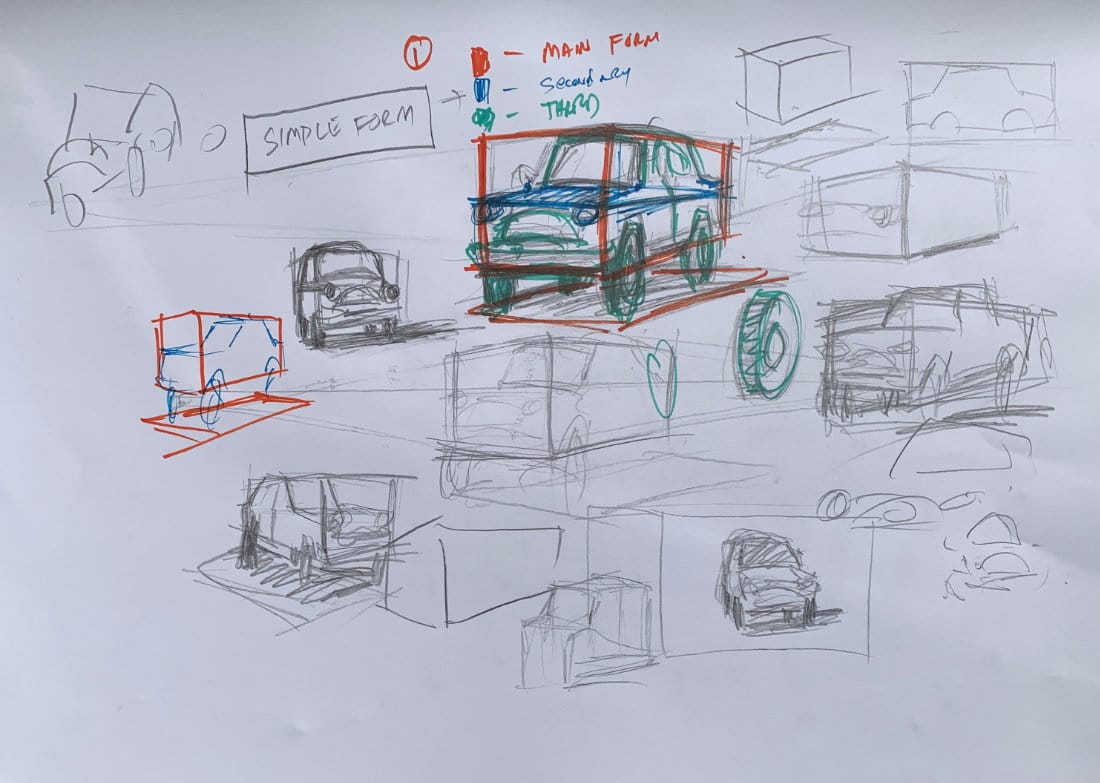
Before worrying about headlights, grills, or windows, the first thing to do is reduce the car to a basic 3D shape. Most cars can be simplified into a box or rectangular form moving through space.
Once you do that, everything else becomes easier.
I always start by asking:
- Which corner of the car is closest to me?
- Which direction is the car moving in space?
- How much of the front vs. the side can I see?
Answering those questions helps you place the car correctly before adding anything else.
Use Your Pencil to Measure Relationships
One of the simplest (and most useful) drawing habits is using your pencil to measure proportions.
You can compare:
- Length vs. width of the car
- Where the windshield starts in relation to the headlights
- How high the wheels sit compared to the body
This keeps you from guessing and helps you avoid that “something feels off” stage later on.
Think in Layers: Primary, Secondary, Details
I like to think of car drawing in three stages:
Primary form
The main box or shape that defines the car in space.
Secondary shapes
Breaking that box up — hood, windshield, roof, and rear.
Details
Wheels, windows, bumpers, headlights, and small accents.
If you jump straight to details without the first two steps, things fall apart quickly.
Cars Are Just Forms Floating in Space
One helpful mindset shift is thinking of the car as a block hovering above the ground, with a shadow underneath. Once you see it that way, perspective makes more sense, and placing the wheels becomes much easier.
This approach works whether you’re drawing cars from photos, imagination, or real life.
Wrap-up
If you can learn to see cars as simple forms first, drawing them becomes far less stressful and a lot more fun. Master the basics, and the details will always follow.